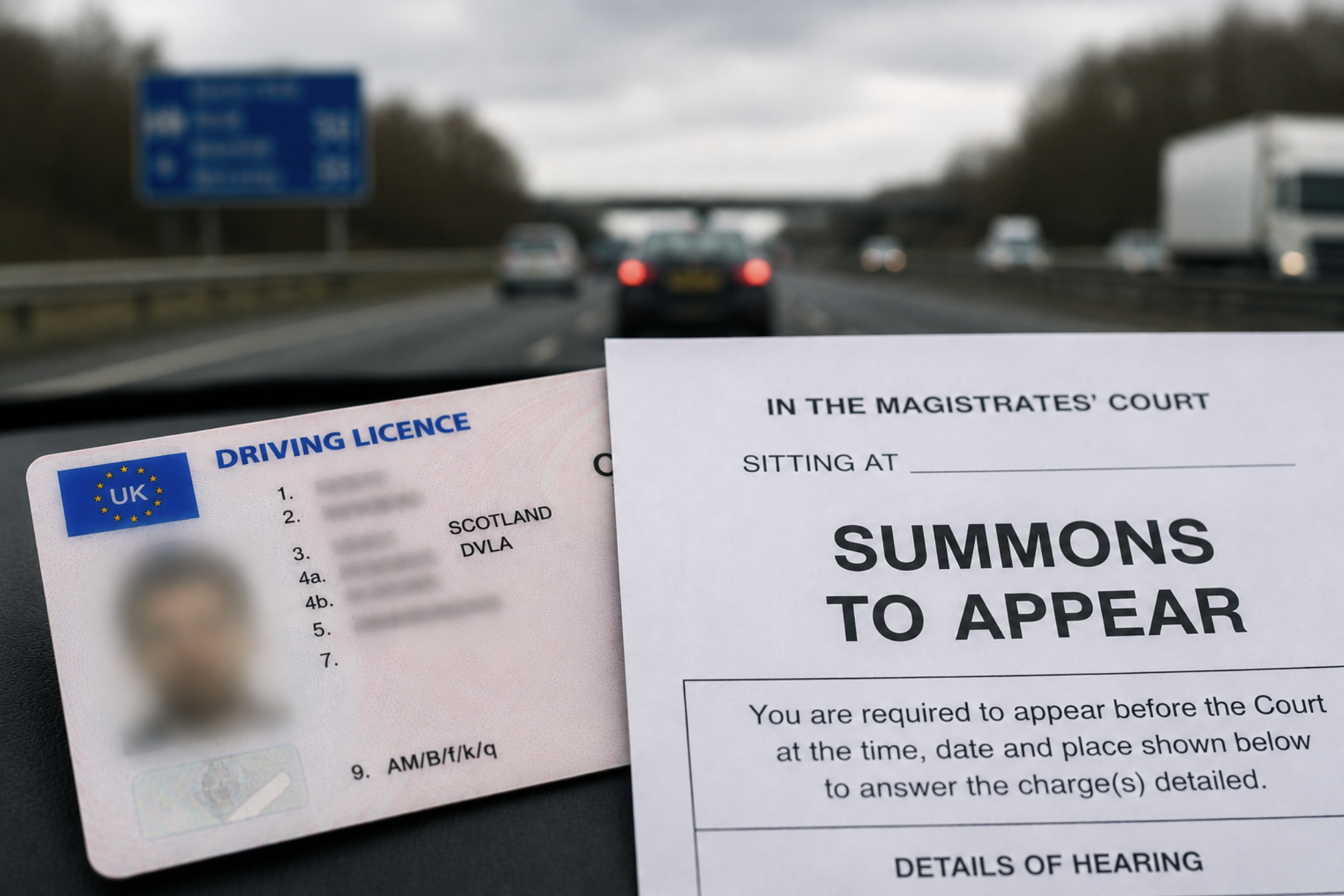
For a driver already sitting on nine points, another speeding charge can look like a foregone conclusion. Three more points means twelve; twelve means a six-month ban; and if driving is how you earn your living, the consequences can reach far beyond losing the use of the car.
The first part of that calculation is straightforward. The second is not.
Under section 35 of the Road Traffic Offenders Act 1988, a driver who accumulates twelve or more relevant penalty points will normally face at least six months’ disqualification under the “totting-up” provisions. The GOV.UK guidance on driving disqualifications confirms the basic position: accumulating 12 or more penalty points within three years can result in a six-month driving ban. The legislation also gives the court power, where the statutory test is met, to impose a shorter period of disqualification or no disqualification at all because of exceptional hardship.
For somebody whose job, business or family depends upon their ability to drive, that can be the difference between a serious motoring problem and a much bigger personal disaster.
Exceptional Hardship Is About Consequences, Not Sympathy
There is no point walking into court and simply saying that losing your licence would be awful. Of course it would. The law specifically distinguishes exceptional hardship from the ordinary hardship that naturally follows a driving ban.
The case therefore has to be built around what would actually happen.
Take a self-employed tradesman with nine points who picks up another three. His van carries tools and materials, his work takes him to sites all over Scotland and there is no realistic way to replace that travel with buses and trains. A six-month ban may not simply make his working day inconvenient; it may make the business impossible to operate.
Now suppose he employs two people whose jobs depend upon that business. He has a mortgage, children and household commitments. Losing his licence could trigger the loss of contracts, the collapse of the business and redundancies for people who had nothing whatsoever to do with his driving offence.
That is a very different argument from, “I need my licence for work.”
And that distinction is precisely where these cases can be won or lost.
The Court Is Entitled to Test the Story
An exceptional hardship argument is not a magic phrase that makes twelve points disappear. The court is entitled to examine the evidence and ask awkward questions.
Could somebody else drive the van?
Could the business employ a driver?
Could work be reorganised?
Could taxis or public transport realistically bridge the gap?
Would the business genuinely fail, or would six months simply be extremely inconvenient?
If the answers are weak, the argument can unravel quickly.
That is why preparation matters. Employment consequences, business finances, caring responsibilities and the impact on innocent third parties may all be relevant, but they need to be presented as a coherent picture rather than a desperate explanation offered for the first time after the sheriff asks why a ban should not be imposed.
The stronger cases tend to be specific. They show not merely that the driver will suffer, but how the consequences travel beyond the driver and why the obvious alternatives will not solve the problem.
There is one further restriction worth knowing. If particular circumstances have already been relied upon successfully as exceptional hardship within the previous three years, those same circumstances cannot simply be used again. Section 35 expressly prevents the court from taking account of circumstances that have already formed the basis of a successful exceptional hardship argument within that period.
If You’re on Nine Points, Another Three Is Not Routine
For a driver with a clean licence, three points may be an irritation. For somebody already on nine, they can put a job, business or family income at risk for six months.
An exceptional hardship argument is never guaranteed to succeed, and any solicitor who suggests otherwise should be treated with caution. But a driver with a genuine case should not assume the ban is inevitable simply because the arithmetic reaches twelve.
There can be a substantial difference between telling the court that a ban would cause hardship and proving why the consequences in your particular circumstances would be exceptional.
If you’re facing a totting-up disqualification, don’t leave the preparation until the morning of court.
Road Traffic Defence represents motorists throughout Scotland facing totting-up disqualification. If another offence could take you to twelve points, contact us before the case is concluded. Six months off the road is too serious to surrender your licence without first finding out whether there is a case to keep it.
Sources
- Road Traffic Offenders Act 1988, Section 35
https://www.legislation.gov.uk/ukpga/1988/53/section/35 - GOV.UK – Driving Disqualifications
https://www.gov.uk/driving-disqualifications - GOV.UK – The Highway Code: Annex 5 – Penalties
https://www.gov.uk/guidance/the-highway-code/annex-5-penalties